Permaculture - Part 1
1. Permaculture: Beyond the Dictionary
The most cliched introduction to an essay is to start with the dictionary definition of the subject. The 2026 version of this is the Al generated summary. So, what does this tell us:
"Permaculture (permanent agriculture/culture) is a nature-inspired design framework for sustainable living that mimics natural ecosystems to create resilient, self-sufficient, and productive systems."
Of course, there is some semblance of truth in this, but Permaculture is a traditional science or ecological knowledge of working, playing and being in partnership and reciprocity with the land and cycles of nature. (Don’t roll your eyes just yet. Read on)
PBS Socal uses the word i_____s science - but that word irks a lot of different people for a lot of different reasons.
Design, ecology and systems lenses allow people coming from different backgrounds and pedagogies to apply permaculture thinking to gardens, farms, conservation, reforestation, community support and other nature-based solutions. The point is not simply to replace one input (synthetic or otherwise) with another, but to redesign the system around the relationships between its elements.
2. Context
A global food system built on synthetic inputs has risks—especially when geopolitical shocks and pandemics collide with climate change. The most critical vulnerability lies not only in the rest of nature, but in the vulnerability of energy markets that power fertilizer production:
2.1 Natural Gas as a Foundational Input
Nitrogen-based fertilisers (e.g., urea and ammonia) require large amounts of natural gas as a feedstock for synthesis (From gas to grain: Fertilizer disruptions raise risks..., UNCTAD 2026). When energy prices spike—driven by war, sanctions, or shipping blockades—the cost of producing these essentials skyrockets.
The Russia-Ukraine conflict serves as the most dramatic example. In the case of India, the country’s expenditure on fertiliser imports doubled and then tripled in the 2 years subsequent to the start of the war.
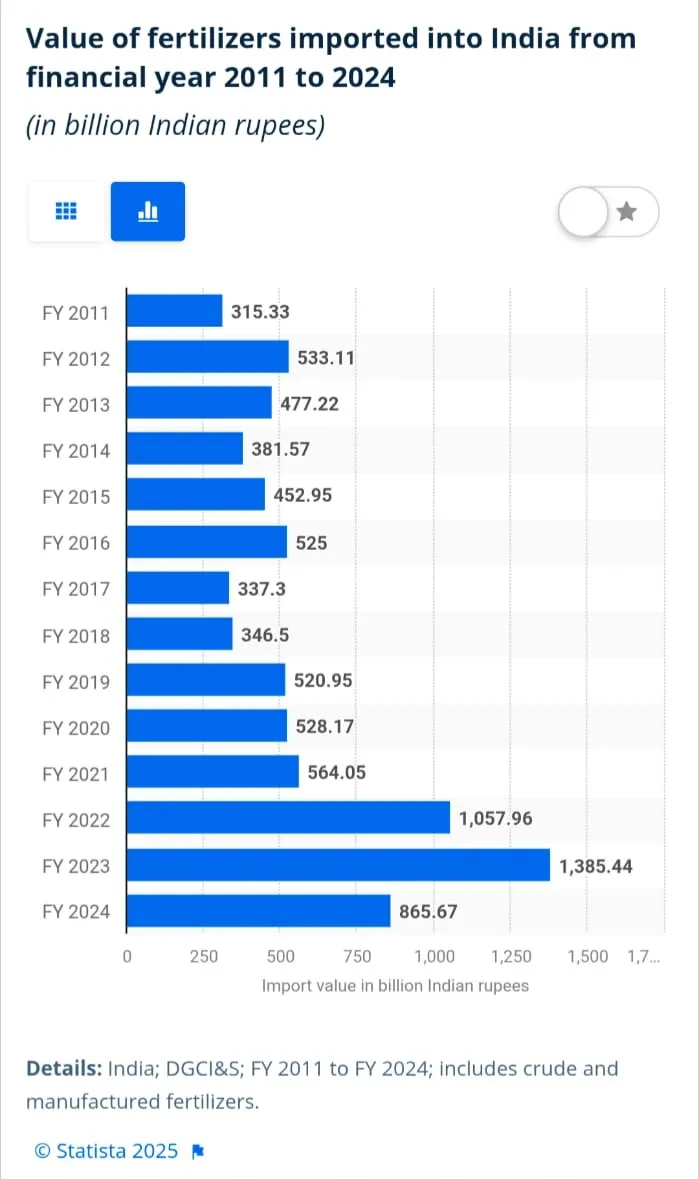
- Energy shocks expose the fragility of chemical agriculture’s model: high input use isn’t sustainable if inputs become unaffordable or unavailable long-term. Without immediate intervention, this creates a feedback loop where farmers deplete soil health to compensate for lack of nutrients—leading to irreversible degradation (Russian ________ Ukraine..., Nature Sustainability).
The takeaway: Fertiliser isn’t just a chemical—it’s an energy-intensive commodity. Disruptions in natural gas flows are a most direct threat to food security.
2.2 Nature, humans & Climate Change: An unusual argument for common ground
There may be some skeptics among you about the relationship of the last few hundred years of human activity and climate change. Litigating that isn’t in the scope of an article like this, so a different approach is taken here.
As someone with a background in Industrial & System Engineering, Supply Chain and Oil & Gas along with exploring, living, volunteering & working in remote parts of the world, I have seen, first hand, the challenges we face from disruptions in weather patterns.
There is another, less obvious response to systemic uncertainty: the bunker mentality. Across parts of the world, people with deep distrust of institutions are preparing for futures in which governments, markets or other people can no longer be relied upon.
For decades, people have been retreating or establishing living premises in rural areas with food supplies and/or food production capability. Reports of billionaires buying ranches in New Zealand and Argentina are daily news now. In my personal experience interacting with those taking such measures, they disregard climate change but fear far-fetched notions derived from fiction and a distrust of their government and humans. Similarly, the billionaires who have established Plan Bs attribute their actions to humans and technology.
Humans, though, are a part of nature. Distinct as we may be. And the technology we create is derived from our ingenuity and dextrous manipulation of materials extracted from the earth. And on a few occasions, space.
One side distrusts institutions and other humans. The other is alarmed by the impact humans have on the planet. Either way, beneath the disagreement is a shared anxiety: the systems we depend on may be less stable than we assume. And interestingly, both camps often arrive at the same practical instinct: greater small-scale food self-sufficiency.
2.3 Population and Network States
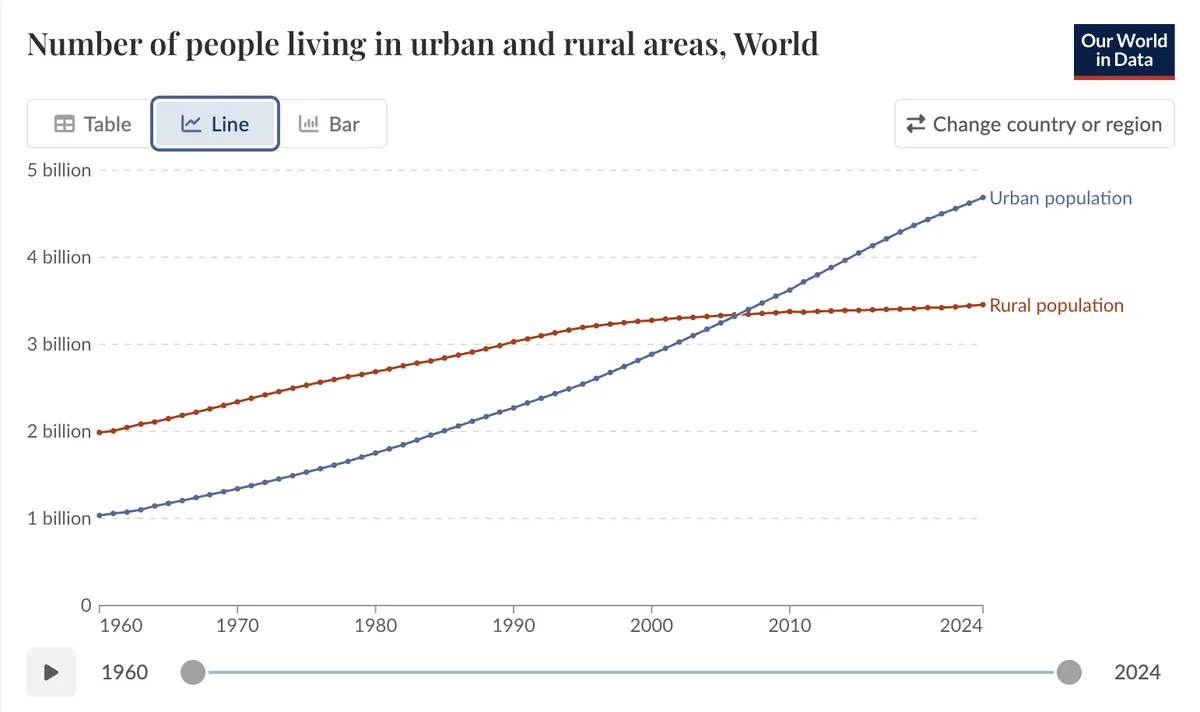
The world's urban population grew by roughly 46% in the last 20 years. Rural populations remain flat. Increasingly, the world is concentrated in metropolitan centres and the urban-rural divide grows.
Balaji Srinivasan, the renowned entrepreneur and investor, has proposed the idea of Network States. As someone who would have gladly lived off Soylent as a college student and young professional, I see the appeal of this kind of thinking, but the Network State manifesto contains almost no detail about where food comes from.
“A network state is a social network with a moral innovation, a sense of national consciousness, a recognized founder, a capacity for collective action, an in-person level of civility, an integrated cryptocurrency, a consensual government limited by a social smart contract, an archipelago of crowdfunded physical territories, a virtual capital, and an on-chain census that proves a large enough population, income, and real-estate footprint to attain a measure of diplomatic recognition.”
Nation-states are not necessarily the final form of human organisation, and forward-thinking alternatives will continue to be explored. Any serious model though has to include an understanding of how people live and the most basic things we need to survive. We consider the latter when planning to colonise Mars, but not Earth?
Permaculture begins with a deceptively simple premise: the systems humans create are not separate from the natural systems that sustain them. They are embedded within them. The question, then, is how do we or our extended machine intelligence design those systems.
3. Origins, Ethics, and the 12 Principles
The term and concept was coined in the 1970s by two Australians, David Holmgren (environmental design), and Bill Mollison (environmental psychology). Observing some of the issues and challenges faced by industrial societies, they learned from communities that had preserved millennia-old practices and introduced a lens of systems & design thinking from academia to transmit this knowledge and create a set of ethics - Planet care, People Care & Future Care - and 12 principles:
Observe and interact
Catch and store energy
Obtain a yield
Apply self-regulation & accept feedback
Use & value renewable resources & services
Produce no waste
Design from patterns to details
Integrate rather than segregate
Use small and slow solutions
Use and value diversity
Use edges & value the marginal
Creatively use and respond to change
Source: Permacultureprinciples.com (Each principle is explained well there for the curious among you)
A Critical Aside: Avoiding App______
As the PBS SoCal article notes, Permaculture has a complicated relationship between Western - itself perhaps a reductive term - counterculture and with the knowledge traditions from which it draws.
It is important to understand that parts of the Western world have treated Permaculture as a creation of their particular mindset. That leads to a significant problem: another body of knowledge becomes something to be app_____ and c______, as has happened with other traditions such as yoga and plant medicine.
In my travels, I have seen this pattern repeatedly in different parts of the world: people become convinced they can “master” a system of knowledge and then teach it back to the communities from which it emerged.
4. Practical Core Concepts
Practically, we can summarise some of the key concepts as follows:
4.1 The Energy Layout (Zoning)
The "common sense" of permaculture is placing things based on how often you use them.
Zone 1 (The Doorstep): Things that need daily care or harvesting, like greens, herbs, and the compost pit, stay right next to the house.
Outer Zones: As you move further away, plants become more self-sufficient (like fruit trees or nut groves), eventually ending in a "wild" zone that requires no maintenance at all.
4.2 Water Management: Sink, Slow, Spread
In permaculture, you want to keep every drop on your land by following the "3 S's":
Sink: Allow water to sink deep underground through percolation tanks etc..
Slow: Use swales (shallow, level trenches) or rain gardens to stop water from rushing downhill and causing erosion.
Spread: Redirect water taking advantage of natural slopes in the land.
4.3 Soil as a Living Sponge
Permaculture treats soil as the living organism or system it is. Rather than disturbing it unnecessarily, one common approach is to keep it covered with organic matter such as straw, leaves or compost. Mulching can help retain moisture, moderate soil temperature and support soil life, reducing the need for some external inputs.
4.4 Vertical Layering (The Food Forest)
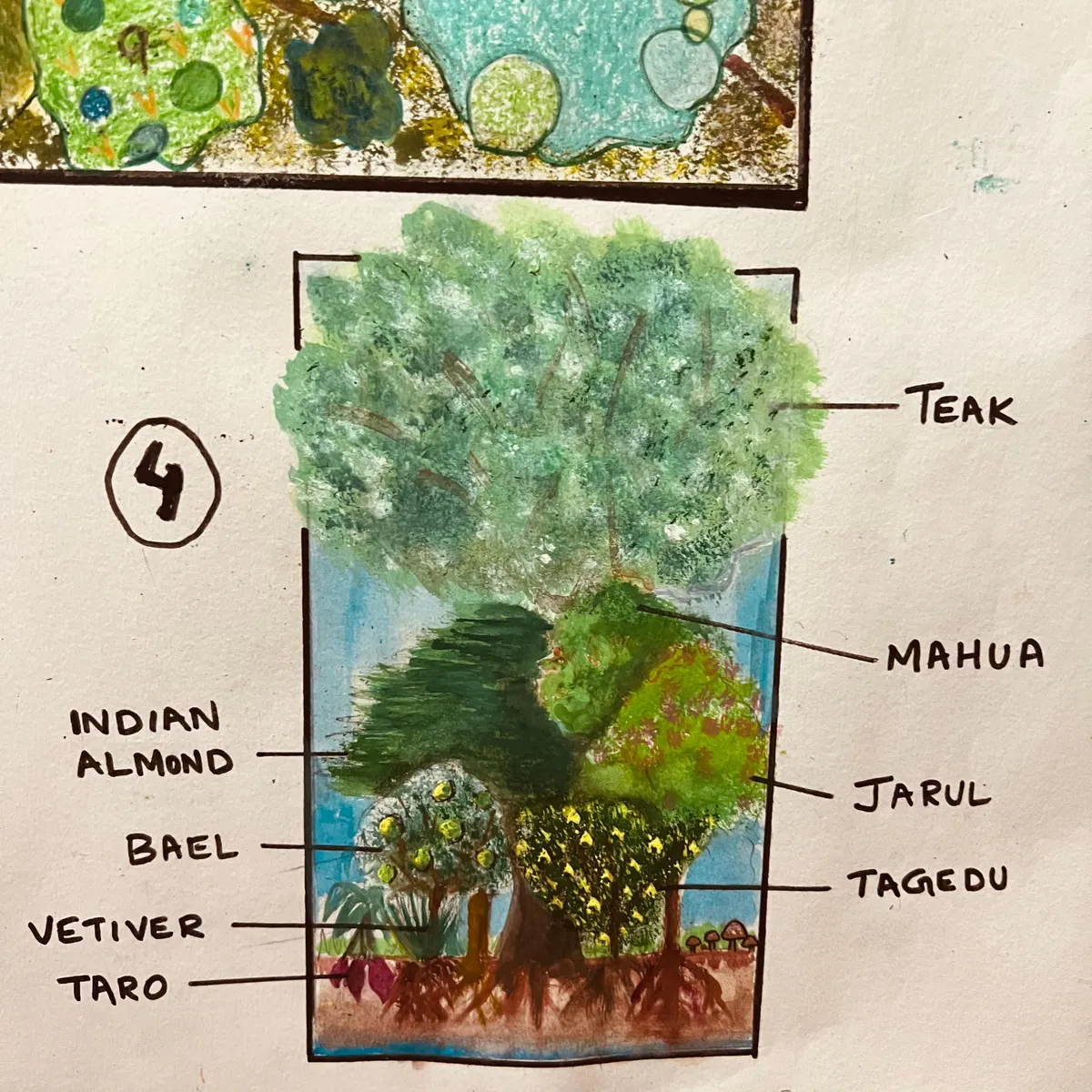
In many natural systems, plants occupy different vertical and horizontal niches. Permaculture can work with that idea through a food forest, combining plants at different heights and rooting depths:
The Canopy: Tall fruit or nut trees.
The Understory: Smaller fruiting trees
The Ground: Vegetables, shrubs, herbs.
The Root: Tubers
The Benefit: The taller layers can shade lower plants and, depending on species and climate, help moderate evaporation and microclimate. Complementary species can also contribute organic matter, nitrogen-fixing, nutrient cycling and other ecological functions.
4.5 Biological "Employees"
Rather than using synthetic input or manual labour, elements from the rest of nature are employed:
Integrated Pest management: Planting certain flowers and leaving wild corners attracts birds, frogs, and ladybugs that eat pests.
Fertiliser: Using chickens or "green manure" crops (plants that add nitrogen to the dirt) feeds the soil naturally.
NB: Please note that these concepts are summarised as an introduction and aren’t exhaustive or definitive.
5. Social Permaculture
It is understandable that not everyone can—or wants to—get their hands dirty in a field. But that misses something important about Permaculture.
The principles are also about relationships, resilience, feedback, diversity and making better use of resources. Thus, they don't stop at the edge of a farm.
This is where Social Permaculture begins.
A lawyer, engineer, designer, teacher or businessperson may never grow a vegetable, yet still have something meaningful to contribute to a ground permaculture implementation— and something to gain from one.
Communities, organisations and human networks can be represented as systems too. They have inputs, outputs, dependencies, waste, redundancies, feedback loops and relationships that can either strengthen or weaken the whole.
That brings us back to where we started. When the systems around us became unreliable in 2020, people didn't just look for ways to grow food. They began looking for different ways of living.
Perhaps the enduring question behind that spike in interest wasn't “How do I grow my own food?”
It was: “How do we build a future that we can sustain and that can sustain us?”
In Part 2, we'll look at three organisations bringing about social and environmental impact using Permaculture.