Permaculture - Part 2 - Case Studies
In order to further explain what Permaculture entails, I'll provide examples of organisations leading the way in this space in very different ways. Each approaches the same underlying principles — observation, relationship, small-scale intervention, self-sufficiency — from a different entry point: one through decades of grassroots land restoration, one through radical volunteer-driven reforestation, and one through waste management as the door into permaculture practice.
Case Study: Aranya Agricultural Alternative
The first is Aranya Agricultural Alternative/ Aranya Permaculture Academy in Zaheerabad, Telangana, India. The Aranya story has been well documented by Andrew Millison of Oregon State University (https://www.youtube.com/watch?v=KhoV-vBAyFI) and other local and regional media. My experience and interaction with them through a Permaculture Design Course, volunteering, developing a land and other initiatives have confirmed the legitimacy of their work.
Mentorship and Grassroots Origins
Narsanna Koppula met Bill Mollison in the 80s and under the mentorship of Dr. Venkat began working at a grassroots level to recover lost practices, educate entire districts and bring about social & ecological change. Working hand-in-hand with his wife Padma Koppula, they have fought for landless people to take ownership of neglected forest lands. In many cases this involved marginalised women cultivating discarded lands in such a way that local authorities ceded these lands to them.
Large-Scale Impact and Water Restoration
They are pioneers in water conservation and restoring wastelands from 1-acre plots for small and marginal women farmers, to large-scale government projects covering up to 1000 acres. In total, they covered nearly 10,000 hectares. Additionally, they have helped 150 families in the Biddakane village practice regenerative agriculture with Permaculture principles.
Native Seeds and Climate Resilience
The preservation of native seeds is another area where they have led the way through the establishment of community seed banks. These seeds are considered to be climate-resilient and are generally not significantly inferior to the oft-repeated notion of high yielding GMO varieties.
Partnerships
A testament to Aranya's capacity and, in general, the Permaculture movement's work with systems and not adversarially is the involvement as a nodal centre with the Indian government's National Mission For Natural Farming, which has enrolled over 20,00,000 farmers and targets over 1% of the country's total agricultural land. Azim Premji Foundation is also presently collaborating with Aranya in the Nirmal district of Telangana to aid over 1200 farmers (generally tribal communities) to transition them from conventional chemical farming & mono-cropping to natural farming following Permaculture principles and reviving traditional methods. Farmers are being encouraged to improve soil health, save native seeds, reduce input costs and diversify income streams through establishment of backyard poultry units, nutrition gardens & fruit orchards.
The Aranya Model Farm and Education
Further living testament is the Aranya farm where Narsanna & Padma transformed a 11 acre arid, rocky land into a globally recognised model Permaculture farm. The practice of zonation is evident there through trellised vegetable gardens, food forests, composting, livestock/poultry, crop fields, mixed forests and a wild area. Here, they conduct a financially accessible 14 day residential Permaculture Design Course providing people the education and hands-on experience they need to begin implementing on their own, do so for others and/or embody Permaculture in their daily life.
Scientific Validation & Legacy
The next generation continues this work as Narsanna's & Padma's daughter Sneha Koppula has been scientifically documenting fungi, visiting birds, snakes, honey bees and other flora & fauna in Aranya.
If Aranya represents decades of grassroots, institution-building, the next case study takes a different route entirely: a single family, no government partnership, and a commitment to radical volunteerism as the engine of restoration.
Case Study: Sadhana Forest
Sadhana Forest is another example. On December 19, 2003, Aviram and Yorit Rozin moved from Israel to Auroville, Tamil Nadu, India, with their one-year-old daughter Osher, and began living on 70 acres of severely eroded, arid land on the outskirts of the community (Sadhana Forest). They came not to occupy, but to restore and regenerate the land into a Tropical Dry Evergreen Forest (TDEF) — an endangered ecosystem unique to the region — with food-bearing trees, practiced through sustainable living, substance-free community life, natural learning, veganism, and a gift economy (Sadhana Forest).
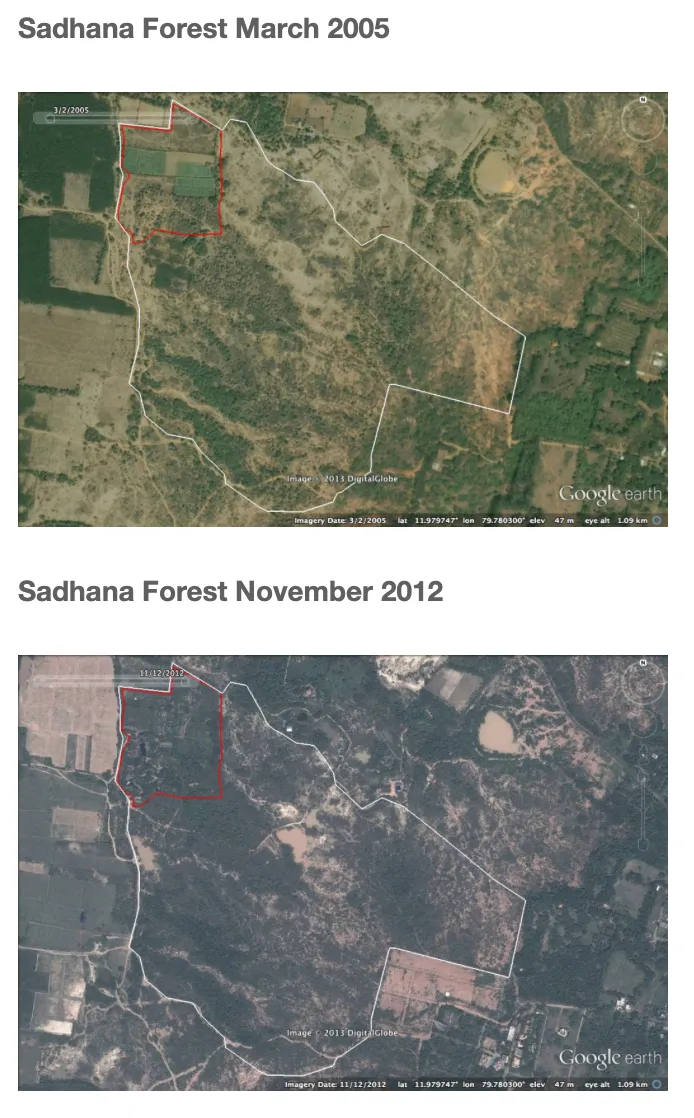
The transformation is measurable: the community has planted over 32,000 trees across 170 species, and more than 53 species of birds and animals have returned to the land (Idealist). The local water table has risen by 6 metres as a direct result of the water conservation work (Homegrown). Sadhana Forest today welcomes over 1,000 volunteers a year from more than 50 countries (Auroville.org), and can host up to 195 people at a time (AUP India).
It now operates 8 long-term ecological projects across 4 countries: India, Haiti, Kenya and Namibia (Wikipedia). Sadhana Forest Haiti began in 2010 after the earthquake, focused on restoring food security around Anse-à-Pitres by reintroducing the Maya nut tree — a food-bearing, carbon-fixing species where each tree can meet roughly 30% of a family's food needs (Idealist). Sadhana Forest Kenya began in 2014 in Samburu County, where recurrent drought and dependency on food aid led the team to establish a training centre and tree nursery on 27 acres, building an indigenous food forest and training local Samburu pastoralist communities in agriculture suited to a semi-arid environment — work that has directly impacted nearly 2,000 people (Idealist).
Volunteer-Driven
A feature of Permaculture is how many organisations and projects thrive by onboarding volunteers to perform many functions that would otherwise require skilled and unskilled labour or (wo)manpower. Sadhana Forest & others rely on the initiative, drive & passion of people showing up to make a difference for the planet and its at-risk communities.
Starting with Water
On-contour swales, bunds, percolation pits, gabions, earth dams, etc. that slow down the flow of rainwater are a feature of how Sadhana Forest begins its work. Growing native, drought-resistant, food-bearing trees and supporting communities flow naturally from there.
Where Aranya works through government partnership and Sadhana Forest through volunteer-powered reforestation, the third organisation in this series arrives at Permaculture from an unlikely starting point: a family's abandoned brick factory, and a waste crisis nobody else was solving.
Case Study: TIEEDI
The third organisation sits above Darjeeling, on land that began as a dumping ground and became a permaculture site employing thirty people.
Origins and Grassroots Cleanup
Tieedi was founded in 2016 by Utsow Pradhan, who grew up in Kurseong and spent two decades studying and working in various cities around India before his last corporate role as National Product Head at an education-technology startup (National Permaculture Convergence). He returned to find that his family's defunct block/brick factory — a plot in Gorabari Village, Sonada Forest, in the Kurseong subdivision of Darjeeling district (Outlook Traveller) — had become an unauthorised dumping ground. The property had served as a hollow-block factory owned by his father for over 40 years, then sat abandoned for two decades before villagers began dumping there (Tiny Farm Lab). Clearing it took months of sustained effort; the site, enclosed by forest, still occasionally surfaces microplastics from that original accumulation.
Pradhan's introduction to Permaculture came not from formal study but from the road: he discovered the philosophy during a backpacking trip in the Himalayas, later formalising that knowledge through a Permaculture Design Certification (StayAltered). The first structure he built was an experimental home of bamboo and mud; it was later dismantled, with the bamboo repurposed into what followed — a Permaculture farm, a set of natural buildings, and eventually guest accommodation, all developed in parallel with the site's core waste-management work.
Operations and Community
Tieedi was registered as an NGO and now runs on roughly thirty staff, two to three volunteers a month, and an average of two guests a day across three cottages — one for a family of four, two smaller ones for families of two or three. Produce from the farm goes directly into the communal kitchen, feeding staff, volunteers, and guests alike — permaculture functioning here less as a philosophy on display and more as the site's actual food system.
The Tripod Model
Pradhan's approach explicitly rejects a one-size-fits-all theory of change in favour of what he calls the tripod model of development: ground-level behavioural change led by the community, policy and municipal alignment to sustain momentum, and initial funding — CSR grants, subsidies — to get the effort moving. Once operational, the model is designed to become self-sustaining: high-value segregated waste is sold back into the market, and that along with other revenue covers the team's operational costs.
Five Verticals
Tieedi organises its work around five pillars: generative tourism (which won an international silver award in London in 2025); zero-waste management, historically the organisation's primary focus; experiential environmental education — work that has run for five years across seven schools in Kurseong and Darjeeling, teaching students composting and how to identify and grow local species (National Permaculture Convergence); the eco-store, currently a single paper up-cycling unit with a cloth up-cycling line in development; and living laboratories, a consulting-facing vertical.
Scale and Recognition
In 2017, a community-led initiative called "Save 8 Mile Khola" set out to save the Khola river, and resulted in three hamlets becoming Zero Waste villages (National Permaculture Convergence). That work has since scaled: per Atharva Chaturvedi, Tieedi's waste-management reach now covers an entire administrative block of roughly 20,000 households, and in 2025 the organisation presented its zero-waste village concept to Prime Minister Modi at the News18 Rising Bharat Summit, building on a pilot in which government college students onboarded 100 households into zero-waste practice. Pradhan has since been recognised as a Local Environment Champion (StayAltered).
The core mechanism is a 53-category waste segregation system, more granular than the standard wet/dry split — schools adopt a manageable subset (often around 10 categories), run a small on-site materials recovery facility, and sell the accumulated segregated waste to vendors once full, generating income for the school in the process. Tieedi has separately begun a "Butt Bank Revolution" targeting cigarette-butt waste, a small but persistent hazard across the cigarette-dense Darjeeling hills, and is expanding its overall waste-processing capacity from 2.5 to 5 tons per month (Give.do).
A Note on The Studies
Unlike Aranya, where years of direct involvement inform the account above, Sadhana Forest and TIEEDI is drawn primarily from conversation with a Forest volunteer who spent five years with the organisation and Atharva Chaturvedi, Tieedi's program manager. This has been supplemented with published reporting rather than a firsthand visit to the site.
In the next article in this series, we look at Permaculture in Asia's newest country.